Like a dance, we move towards and away from something so that our nervous system, mind and body can process what is occurring whilst learning to get comfortable with difficult emotions or when being out of our window of tolerance. We’re practicing self-regulating, finding balance and staying flexible in the present moment. So we start by grounding ourselves, and then feeling what’s arising for us, be it a thought, emotion, mood or sensation, and where it gets uncomfortable, we shift our attention back to our breath or a part of the body that feels safe for us, for example the belly or feet, and returning again to feeling what’s arising. We allow ourselves to move from one point to another according to what feels “safe” or “right” for us – a titration process.
It is a useful meditation when you’ve had a hard day and are finding it difficult to sit, or if you generally find it hard to sit through a meditation due to constant intrusive thoughts and difficult emotions. Also useful for those who are experiencing PTSD or had experienced trauma and are wanting to practice meditating as part of healing.
Sometimes we take life, our experiences, our unwelcome emotions too seriously. This meditation is a reminder to live life with a sense of lightness and playfulness.
Let Your Life Lightly Dance, by Rabindranath Tagore
To the guests that must go bid God’s speed and brush away all traces of their steps. Take to your bosom with a smile what is easy and simple and near. Today is the festival of phantoms that know not when they die. Let your laughter be but a meaningless mirth like twinkles of light on the ripples. Let your life lightly dance on the edges of Time like dew on the tip of a leaf. Strike in chords from your harp fitful momentary rhythms.
Rumination—thinking, thinking, going around in circles—brings us down the spiral, and causes depression, anxiety and stress. The invitation is to disengage from it, setting your thoughts free, and using the body to hold you steady.
Whenever you’re feeling down, overwhelmed, anxious, have hope that these feelings don’t last forever and we’ll find our way home eventually. Inspired by “Hope” is the thing with feathers, by Emily Dickinson.
“Hope” is the thing with feathers – That perches in the soul – And sings the tune without the words – And never stops – at all –
And sweetest – in the Gale – is heard – And sore must be the storm – That could abash the little Bird That kept so many warm –
I’ve heard it in the chillest land – And on the strangest Sea – Yet – never – in Extremity, It asked a crumb – of me.
Arriving and embracing the present moment with the people around you instead of frequently being lost in the head with our thoughts, often reviewing the past or speculating about the future, or being buried in our mobile phone.
Inspired by Zen monk Thich Nhat Hanh’s poem: Please Call Me by My True Names (extract).
Don’t say that I will depart tomorrow —
even today I am still arriving.
Look deeply: every second I am arriving
to be a bud on a Spring branch,
to be a tiny bird, with still-fragile wings,
learning to sing in my new nest,
to be a caterpillar in the heart of a flower,
to be a jewel hiding itself in a stone.
I still arrive, in order to laugh and to cry,
to fear and to hope.
The rhythm of my heart is the birth and death
of all that is alive.
My joy is like Spring, so warm
it makes flowers bloom all over the Earth.
My pain is like a river of tears,
so vast it fills the four oceans.
Please call me by my true names,
so I can hear all my cries and my laughter at once,
Happy 2022! The mind is an incredible machine that generates ideas, solves problems but it can also produce thoughts that cause us grief and make us do things that we regret. How do we practice disengaging especially from thoughts that are not true, not realistic, not useful and only serve to weigh us down?
Inspired by the tradition of Soto Zen, we simply watch our thoughts, coming and going as they are as we are a third party, not identifying ourselves with thoughts, not judging, not needing to react to every single thing the mind tells us to do. Here we are just sitting quietly and watching. The pause allows wisdom to emerge and perhaps a new found appreciation for how the mind works.
Emily Dickinson describes this in her poem (extract).
The Brain — is wider than the Sky — For — put them side by side — The one the other will contain With ease — and You — beside —
The Brain is deeper than the sea — For — hold them — Blue to Blue — The one the other will absorb — As Sponges — Buckets — do
As we wind down for the year and set New Year resolutions, we anchor on what the heart longs for without judging ourselves. Simply just holding our desires in mindful awareness and allowing whatever emotions that arise when we bring to mind and feel in the heart what we truly want at the deeper level.
Inspired by William Wordsworth The Rainbow (or My Leaps Up). Life begins when we embrace our humanity with grace, and acknowledge what we really want even if it’s not within reach or seems silly.
Radical self-love by paying attention to the body with care and compassion is a way to tap into our subconscious wisdom for guidance instead of being confined by limiting stories and beliefs the mind tells us. We end with this poem on Self-Love by e.h. (Erin Hanson).
Every heart’s a hurricane, Each soul a starlit sea, Every mind’s a meteor Unbound by gravity. And everybody’s wishing They could learn to tame their tides, When nothing more than nature Is what’s echoing inside. Every life’s a lightning bolt, Yet everyone’s told no; Bite back all your thunder And don’t let the wild things show. Every heart’s a hurricane, Everyone a world within, Every life too short for loathing Any storms beneath your skin.
If every day is precious, every moment is too. This practice is about taking the time to just be, to appreciate the preciousness of each moment as it is. To just sit without constantly living in the head, in our stories and plans. Finding the balance instead of striving or planning in the head on how to strive. Being in the being mode.
Inspired by Days, written by Billy Collins, former US Poet Laureate.
The question of the day is: what will you let go of? Here is a meditation session of learning to let go of what upsets and weighs us down, recognizing that all our experiences, good and bad, are impermanent. Often thoughts and desires that accompany the feelings magnify our distress, the need for things to be in a particular way, like the need for us to stay calm and centered during a meditation. Otherwise the session feels like a waste of time. Actually the best time to practice is when the mind is unsettled. We’re cultivating accepting situations or reality as they are before deciding on the next best response.
Today’s Wednesday Pause is a practice of self-love. Cliche as it sounds, its really an invitation to be gentle with ourselves, meaning whatever that is arising, whether we like it or not or find it inadequately stimulating, we gently accept the moment as it is. This reduces the hold unpleasant feelings has over us. And if we find ourselves experiencing strong emotional energy be it grief and anxiety, we respond with gentleness without needing “to do something” to fix it and make it go away. It’s as if you respond with gentle energy instead of brute force, counterintuitive as it may seem.
Inspiration sought from Walt Whitman’s poem Song of Myself (1892, extract).
I celebrate myself and sing myself
And what I assume, you shall assume
For every atom belonging to me, as good belongs to you.
We practice directly experiencing reality instead of through the filters of the mind which is easily clouded by cravings and fears. Our thoughts often demand that situations have to be in a particular way and we are dissatisfied when they are not. Why not accept life as it is, moment-by-moment, in its ups and downs so that we can respond wisely instead of in a deluded way that only prolongs suffering? There’s more to life than “should be”s, labels and opinions. Inspired by Lao Tzu’s Tao Te Ching verse 12.
The five colours blind the eye. The five tones deafen the ear. The five flavours dull the taste. Racing and hunting madden the mind. Precious things lead one astray.
Therefore the sage is guided by what he feels and not by what he sees. He lets go of “that” and chooses “this”.
This is a practice of decoupling or de-centering from mental chatter, and viewing thinking as a mental event. It’s often not easy as our thoughts are so compelling and urgent, requiring us to act on them immediately, in the process exhausting us. Here we develop our capacity to observe and let go of the need to answer back or to react toward our thoughts. The practice ends with a reading of Robert Frost’s poem The Sound of Trees (extract).
Here’s the full poetry.
I wonder about the trees. Why do we wish to bear Forever the noise of these More than another noise So close to our dwelling place? We suffer them by the day Till we lose all measure of pace, And fixity in our joys, And acquire a listening air. They are that that talks of going But never gets away; And that talks no less for knowing, As it grows wiser and older, That now it means to stay. My feet tug at the floor And my head sways to my shoulder Sometimes when I watch trees sway, From the window or the door. I shall set forth for somewhere, I shall make the reckless choice Some day when they are in voice And tossing so as to scare The white clouds over them on. I shall have less to say, But I shall be gone.
This practice is about meeting anxiety as and when it arises. Anxiety is often characterized by a fast beating heart, sweaty palms, and maybe throbbing pain in the head. The feelings seem unpleasant, naturally compelling us to want to push them away or to get rid of them. By giving in to this reaction, we are merely avoiding and allowing anxiety to have a grip over us. We are not learning how to respond skillfully to difficulties.
The invitation is to allow ourselves to witness whatever that is arising by pausing from judging, staying as still as we can (not needing to react), and staying with the experience (not needing to run away, distract ourselves or zone out). If the feelings are overwhelming, we approach by dipping our toes and homing in slowly, as best as we can seeing anxious feelings as transient (even if they seem to last forever or they’re recurrent), and as merely outcomes of the mind and body (even if they seem so real). They do not define our identity, they are simply experiences, and we can choose how to respond to them. The response can be not to do anything but simply to just observe and embrace all life experiences as they are.
Poetry for today is Between Going & Staying, by Octavio Paz (translated).
Feeling tone or feeling sense is a sense of awareness that we typically interpret as unpleasant, pleasant or neutral. It is what puts us in a foul mood or a good one. The Pali translation in Buddhist text is “vedana”.
It is natural to desire pleasant experiences, to avoid unpleasant ones, and to zone out or feel bored, restless and even empty when there are neutral feelings (the mind constantly need stimulation). It is those underlying desires that cause us to be unhappy or stressed when things are not going according to our wishes.
The antidote is to become conscious of and to tune in to any feeling tones so that we are aware what is causing us to “suffer” in the first place. And then, we let these feelings come and go without needing to get caught up in them. We weaken the grip of reactivity, and find peace.
The practice ends with the poem On Pain by Khalil Gibran:
And a woman spoke, saying, Tell us of Pain.
And he said: Your pain is the breaking of the shell that encloses your understanding.
Even as the stone of the fruit must break, that its heart may stand in the sun, so must you know pain.
And could you keep your heart in wonder at the daily miracles of your life your pain would not seem less wondrous than your joy;
And you would accept the seasons of your heart, even as you have always accepted the seasons that pass over your fields.
And you would watch with serenity through the winters of your grief.
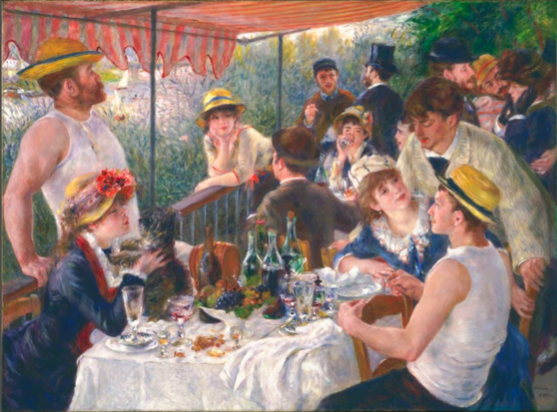
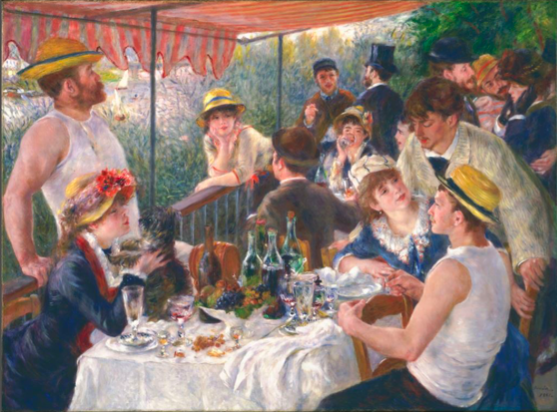
Luncheon of the Boating Party, by Pierre-Auguste Renoir, 1881. Image: Phillips Collection.
The painting above, Luncheon of the Boating Party is one of Renoir’s finest masterpieces, and one of his last Impressionist work. More interestingly from my perspective, it was painted using his left hand because he broke his right, but the awkward experience ended up giving him new inspiration. He wrote in a letter to a patron: “It’s even better than what I did with the right (hand). I think that was a good thing that I broke my arm. It allows me to make progress.”
That’s the essence of the program I teach, Mindfulness Based Cognitive Therapy (MBCT)—giving ourselves permission to respond in new ways to difficulties instead of falling back on the security of our habitual “doing” tendencies. In the process learning new wisdom.
Q: What is mindfulness?
Mindfulness is about intentionally paying attention to the present moment with non-judgement. We pay attention to what is arising on the outside such as smell, and in our inner world: thoughts, emotions, physical sensations, impulses to act, and feeling-tones. We assume a sense of equanimity, which means staying engaged and accepting whatever that has arisen or is arising without needing to like nor dislike the experience. It is aided by bringing to bear the attitude of a beginner’s mind or curiosity, and kindness or friendliness. By doing so, the mind is more steady and less reactive. We can be more wise in our actions and speech.
Q: What then is Mindfulness Based Cognitive Therapy (MBCT)?
MBCT combines mindfulness practices and cognitive therapy principles. Three psychology professors—John Teasdale (Cambridge), Mark Williams (Bangor, now Oxford), and Zindel Segal (Toronto)—developed MBCT with the aim of providing a non-drug alternative to reducing depression relapses. This was in the 1990s. MBCT is approved by NHS England and is now also widely taught to the general population to deal with stress and to flourish. Together with MBSR (Mindfulness Based Stress Reduction), MBCT is considered a gold standard secular mindfulness program because they are evidence-based, and observe rigorous teaching standards.
MBCT starts off by learning to switch out of autopilot and to ground ourselves. Henceforth we are more awake, anchored and less automatically derailed by triggers. We remain guided by our values, and have more capacity to be calm, compassionate and resilient.
Cognitive therapy is widely used by psychologists to help clients become aware of how their thoughts and feelings drive behavior. Here we appreciate that thoughts and feelings are simply outcomes of the mind and body processes. They are outside our locus of control, they are impermanent and innocuous. Hence, instead of striving to get rid of thoughts and feelings which had already arisen eg anxiety, we stay in the present moment and focus our energy on what we can do, which is forging a kind relationship toward them. Eventually anxiety reduces its grip.
All this sounds easy and logical but when we are caught in the heat of the moment, we easily lose sight of this wisdom. That’s why we practice mindfulness frequently to allow the mind to unlearn and learn new habits. I am learning this every day!
Q: Is MBCT about just letting it be, not progressing and changing our circumstances?
Generally, our default reaction to difficulties is to “do something” eg ruminate, blame others, avoid, suppress, neutralize with positive thoughts (even if they are untrue or unvalidated), or to keep ourselves busy and distracted. We can’t help ourselves! Mindfulness calls for a different response of non-doing. Something far less exhausting.
The invitation is to connect directly with our inner world experiences (as opposed to analyzing them in our head), to practice letting go of the need to get rid of or to fix unwanted experiences, and to accept our humanity its warts and all. This creates conditions for us to be more flexible and to see a bigger perspective rather than be ruled by our “lizard brain”. So we are on a more steady footing to decide our next course of action instead of habitually launching into avoiding, distracting, and running around in circles.
Q: Is MBCT or mindfulness religious-based?
MBCT is adapted from MBSR (Mindfulness Based Stress Reduction) and adds to it the understanding of cognitive therapy. Jon Kabat Zinn started a stress reduction clinic and developed MBSR at the University of Massachusetts Medical School in the 1970s. His work is influenced by his yoga and Buddhist practices of calm, compassion and insight by simply accepting the present moment as it is; and to integrate these teachings with empirical research. To date, more than a thousand studies have been done on the efficacy of mindfulness-based programs, mostly showing positive or promising results for responding to physical and mental health conditions eg stress, chronic pain, depression, and anxiety.
MBSR/MBCT is informed by Buddhist psychology that suffering eg unhappiness is due to cravings and aversions formed by our non-discerning (unwholesome) judgements. But MBCT/MBSR is not Buddhism per se because it does not prescribe core Buddhism beliefs of rebirth and karma.
It should also be noted that mindfulness and meditation are mentioned in all mainstream religions. They just differ in purpose. For Christians, the centre of awareness is God while Buddhism is about achieving enlightenment (nibbana) that requires a high level of concentration.
MBCT/MBSR is about practicing equanimity and kindness in responding to life. The anchor is whatever that is available such as sound. MBCT/MBSR program is therefore universal and secular. It is about uncovering the masterpiece within us.
For more info about my MBCT course, see 8-Week Mindfulness (Jul-Aug) here
Feel free to join my talk on the Art & Science of Mindfulness to get more details about how MBCT works. On Wed, 26 May, 7:30 – 8:30pm MYT/SGT/HKT via Zoom. Register on Eventbrite at www.bit.ly/asmindful4
Drop me a note if you have any questions or feedback: noellelimlj@gmail.com
During this Eid festive season, the invitation is to allow the mind to quieten and the body to rest and recharge. For those who had or will be receiving their vaccination shots for Covid-19, this mini body scan offers a helpful response to ensuing side effects like fever and body aches. Stay safe and healthy.
Inspired by Keeping Quiet by Pablo Neruda.
Life is what it is about…
If we were not so single-minded about keeping our lives moving, and for once could do nothing, perhaps a huge silence might interrupt this sadness of never understanding ourselves and of threatening ourselves with death.
Now I’ll count up to twelve and you keep quiet and I will go.
Transitions in our external world are also felt inside us, expressed in changing thoughts, emotions and sensations in the body. Sometimes the transitions feel painful, uncertain, worrying or hopeful. We may end up more fixated with the destination and lose the opportunity to learn something new about us in the process of transitioning. To get comfortable with change, we practice getting comfortable with transitions experienced in our inner world. This is done by noticing our experiences moment-by-moment while keeping our awareness on the breath and accepting whatever that is arising with a welcome mat.
Register to join us in future Wednesday Pause mindfulness practices here
For a complete archive of our meditations, visit here
Inspired by the poem I Am A Transition (extract), by Emu Getachew
Transition…I think I am? I am a progression!
I am the vacancy between the alphabets.
My feet travel silently.
Back and forth-side to side with a blazing desire to transit.
Asking who I am?
I am a transition-I reply, not a completion.
But a passage, traveling between the alphabets of time in self-expedition.
A thought easily produces a chain of ideas, intentions, stories, and next thing we know, time has passed. Life has passed. Sometimes we unwittingly shoot another arrow, for example, chiding ourselves for having certain thoughts.
Another trap is when a negative thought arises, we think “positively” to “neutralize”. That is helpful if the intention is to see a more realistic picture. It is not helpful if we’re adding thoughts that are potentially false and speculative simply to make ourselves feel better or to justify ours or other peoples’ actions. It’s a survival instinct.
An alternative response is to let thoughts be like water flowing in the stream instead of adding more. And if we choose to, mindfully directing our energy to thoughts that really matter and to be kind to ourselves for having thoughts. We look deep down to find what matters and what is true for us.
Practicing mindfulness helps us deal with impatience because it seems like it has a relationship with time – needing things now or yesterday. A practice might seem to take forever because our minds constantly need to be stimulated and “satisfied”. It’s this constant shifting attention, always searching, never resting, that keeps us in reactionary mode. So instead of perpetually seeking stimulation and getting lost in our thoughts and stories, the invitation is to engage with the present moment differently, and to be able to just sit with the passage of time.
The inspiration of this practice came from a poetry by Rabindranath Tagore.
The butterfly counts not months but moments,
and has time enough.
Time is a wealth of change,
but the clock in its parody makes it mere change and no wealth.







 Kindermind Center