We’re always running, on a constant treadmill, wanting to be somewhere else. How about just accepting that you’re where you need to be right this moment – sitting, closing the eyes, meditating. What if we just paused and embraced the moment.
A practice of meeting each moment—whether we welcome it or not—with softness rather than resistance so that we can sit with whatever experience that arises and not be so ruffled. Words by Rumi guide.
Thinking, working too fast and constantly striving would kill our wellbeing. Here is an invitation to slow down, inspired by Thich Nhat Hahn’s poem Drink Your Tea, and in honor of his memory.
Whenever you’re feeling down, overwhelmed, anxious, have hope that these feelings don’t last forever and we’ll find our way home eventually. Inspired by “Hope” is the thing with feathers, by Emily Dickinson.
“Hope” is the thing with feathers – That perches in the soul – And sings the tune without the words – And never stops – at all –
And sweetest – in the Gale – is heard – And sore must be the storm – That could abash the little Bird That kept so many warm –
I’ve heard it in the chillest land – And on the strangest Sea – Yet – never – in Extremity, It asked a crumb – of me.
Arriving and embracing the present moment with the people around you instead of frequently being lost in the head with our thoughts, often reviewing the past or speculating about the future, or being buried in our mobile phone.
Inspired by Zen monk Thich Nhat Hanh’s poem: Please Call Me by My True Names (extract).
Don’t say that I will depart tomorrow —
even today I am still arriving.
Look deeply: every second I am arriving
to be a bud on a Spring branch,
to be a tiny bird, with still-fragile wings,
learning to sing in my new nest,
to be a caterpillar in the heart of a flower,
to be a jewel hiding itself in a stone.
I still arrive, in order to laugh and to cry,
to fear and to hope.
The rhythm of my heart is the birth and death
of all that is alive.
My joy is like Spring, so warm
it makes flowers bloom all over the Earth.
My pain is like a river of tears,
so vast it fills the four oceans.
Please call me by my true names,
so I can hear all my cries and my laughter at once,
Happy 2022! The mind is an incredible machine that generates ideas, solves problems but it can also produce thoughts that cause us grief and make us do things that we regret. How do we practice disengaging especially from thoughts that are not true, not realistic, not useful and only serve to weigh us down?
Inspired by the tradition of Soto Zen, we simply watch our thoughts, coming and going as they are as we are a third party, not identifying ourselves with thoughts, not judging, not needing to react to every single thing the mind tells us to do. Here we are just sitting quietly and watching. The pause allows wisdom to emerge and perhaps a new found appreciation for how the mind works.
Emily Dickinson describes this in her poem (extract).
The Brain — is wider than the Sky — For — put them side by side — The one the other will contain With ease — and You — beside —
The Brain is deeper than the sea — For — hold them — Blue to Blue — The one the other will absorb — As Sponges — Buckets — do
Closing 2021 with a gratitude mindfulness practice, bringing to mind whom we’re grateful for, and what we’re grateful for this year and right this moment. Happy 2022, and make the leap, folks!
As we wind down for the year and set New Year resolutions, we anchor on what the heart longs for without judging ourselves. Simply just holding our desires in mindful awareness and allowing whatever emotions that arise when we bring to mind and feel in the heart what we truly want at the deeper level.
Inspired by William Wordsworth The Rainbow (or My Leaps Up). Life begins when we embrace our humanity with grace, and acknowledge what we really want even if it’s not within reach or seems silly.
Whenever we’re feeling down, upset, angry or worried about something, using stillness might be helpful. It’s about allowing our emotional energy to find a resting point. Inspired by this poem Stillness by Karen Lang.
Radical self-love by paying attention to the body with care and compassion is a way to tap into our subconscious wisdom for guidance instead of being confined by limiting stories and beliefs the mind tells us. We end with this poem on Self-Love by e.h. (Erin Hanson).
Every heart’s a hurricane, Each soul a starlit sea, Every mind’s a meteor Unbound by gravity. And everybody’s wishing They could learn to tame their tides, When nothing more than nature Is what’s echoing inside. Every life’s a lightning bolt, Yet everyone’s told no; Bite back all your thunder And don’t let the wild things show. Every heart’s a hurricane, Everyone a world within, Every life too short for loathing Any storms beneath your skin.
If every day is precious, every moment is too. This practice is about taking the time to just be, to appreciate the preciousness of each moment as it is. To just sit without constantly living in the head, in our stories and plans. Finding the balance instead of striving or planning in the head on how to strive. Being in the being mode.
Inspired by Days, written by Billy Collins, former US Poet Laureate.
Our thoughts could be discouraging, demotivating, compelling us to quit. This is a meditation of practicing staying the course, not giving up so easily. Inspired by I Bend, a poetry written by Selena Odom.
I bend but do not break.
I’ve been lost, but I’m not a loser.
I’m a wreck, but I’m not totaled.
I’m fractured but not broken.
I’ve failed, but I’m not a failure.
I’ve fallen hard but can get up again.
I’m isolated, but still I’m free.
I have been destroyed but will rebuild.
My heart is broken, but it will mend.
See, no matter how close I come to breaking, I just continue to bend.
The question of the day is: what will you let go of? Here is a meditation session of learning to let go of what upsets and weighs us down, recognizing that all our experiences, good and bad, are impermanent. Often thoughts and desires that accompany the feelings magnify our distress, the need for things to be in a particular way, like the need for us to stay calm and centered during a meditation. Otherwise the session feels like a waste of time. Actually the best time to practice is when the mind is unsettled. We’re cultivating accepting situations or reality as they are before deciding on the next best response.
Ruminating or over-thinking, thinking in circles with no solution in sight, making inferences that are not valid, is exhausting and kills our wellbeing. This is an invitation to come home to ourselves, to be in the present moment instead of getting lost in the jungle of our striving, depressive and anxious thoughts. An act of coming home is to be present with the body or the breath. So each time we find our minds slipping away into rumination, we bring the mind back to the body, we come back home.
This draws inspiration from the poetry by Oriah Mountain Dreamer, Coming Home To Myself. It speaks about mindfulness – savoring the present moment as it is.
I had wandered so long
I’d stopping missing or even looking for myself.
But I longed.
Although even that became muted,
an underwater echo, blue green, and easy to miss.
Each day now a little more of who I am
is retrieved from the ocean floor:
the pleasure of my own cooking—
fresh eggs scrambled
with rosemary, and mushrooms, and sharp cheese;
the feel of silk across the back of my neck,
a cool caress to tender skin,
reawakening the need for touch;
the strength in my legs,
the joy of taking long strides with nowhere to go;
the quiet of the morning,
as I sit facing east just before the sun appears,
and then, the moment when the sun crests the horizon,
my gaze behind closed eyes flaring crimson and gold.
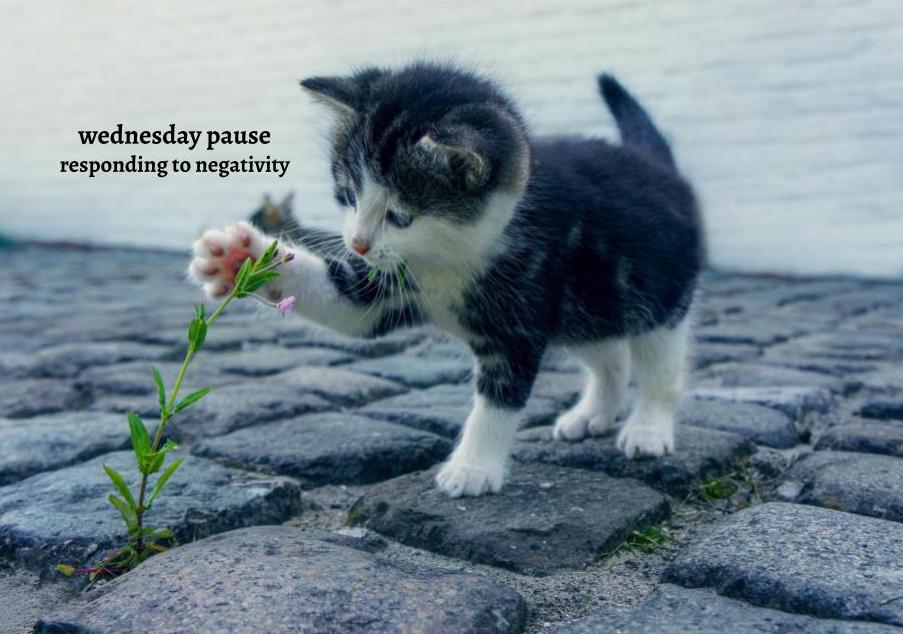
It’s easy for negative thoughts or negative inferences to take root. They can be as subtle as “I can’t do this” to something extreme we won’t say to others like “You’re (I’m) stupid”, or excessive worry and downplaying ourselves or others.
One outcome of negativity is that it can lead us to a striving mode, needing to fix or improve ourselves. We sign up for a bunch of courses, throw ourselves into projects to shut off the pain, make ourselves feel like we’re progressing in life. A striving mode can also mean to deliberately avoid situations.
This is not to say we don’t do anything to improve our life outcomes or to purposely invite difficulties, but we want to be more discerning about what thoughts we want to act on and what actions are really necessary, lest we end up distressing ourselves further or shy away from living a full life.
In this meditation, we acknowledge thoughts as they are (just thoughts), and practice restoring a sense of being or balance. When we’re in a less driven-doing, judgmental mode, we can see our priorities and what really matters with more clarity.
We also use the poem Negative Thoughts (extract) by Murray Lachlan Young to convey the theme of the practice.
Negative thoughts
Oh, they come and they go
And sometimes they come
A lot more than they go
Then do what they like
And say what they please
To stifle your life
With their negative squeeze
So why not breathe in
And exercise choice
Why not breathe out and say “No” to the voice
And say “I’m worth more much, much, more than all that
And that negative voices
Are uncool and old hat”
So why not decide
That it’s time to get free
And stand up to the (deeply uncool) voice
Of Negativity
Guide: Noelle Lim
Duration: 14 mins
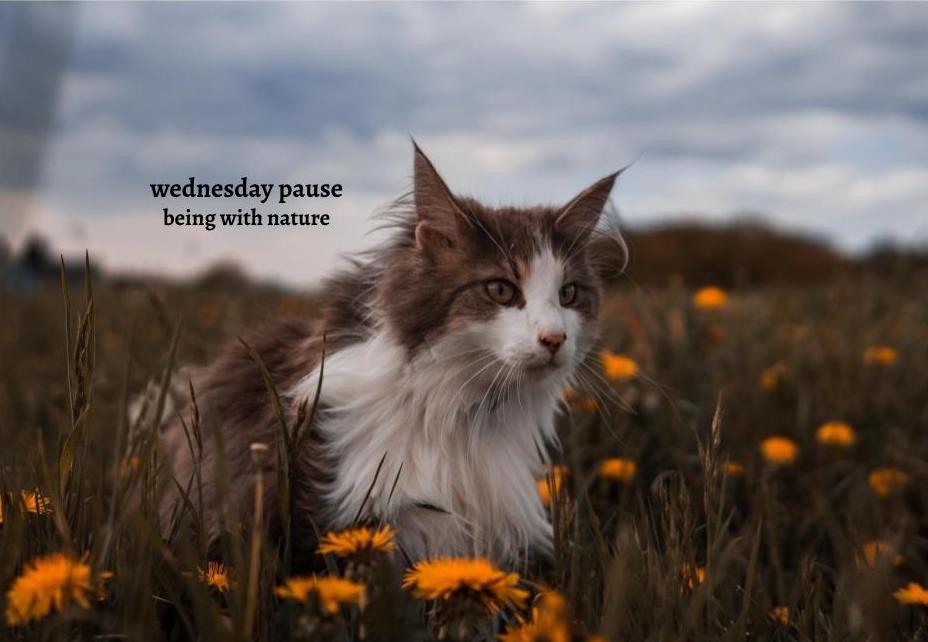
Image credit: Dim Hou, Unsplash
To register and join our Wednesday Pause meditation, please go here
To view the complete archive of our meditations, go here
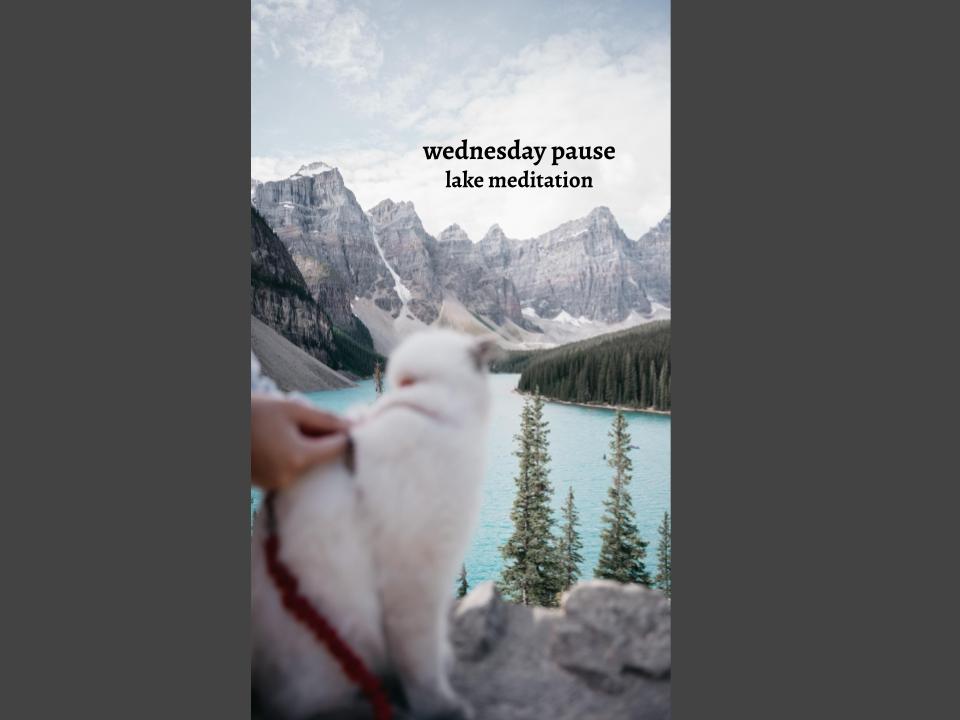
This is an adaptation of the Lake Meditation written by Jon Kabat Zinn, founder of MBSR (Mindfulness Based Stress Reduction). We are cultivating the qualities and energy of a lake – silent, merely reflecting back what it sees as it is, and returning to stillness whenever the wind, rain and storm pass. Visualizing ourselves as the lake. Like it, we can return to our original being of stillness and silence once unwelcome thoughts and feelings move on.
We end with this poetry There In The Stillness by Show You Love (extract).
There in the stillness, the whisper of angel’s wings
There in the stillness a place for beggars and kings
There in the stillness a fluttering of the soul
There in the stillness someone broken is being made whole
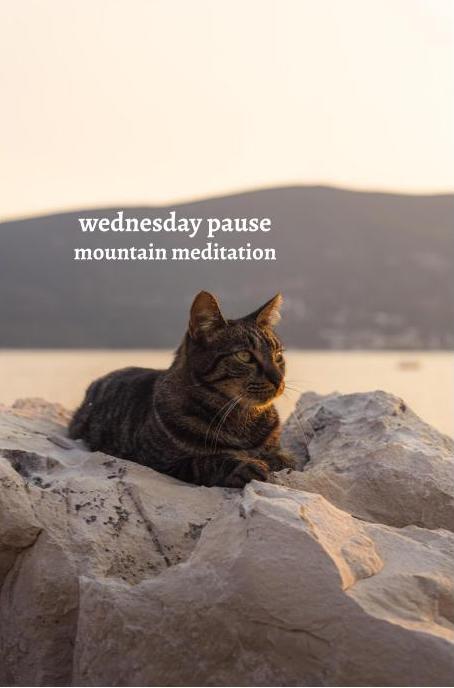
This is an adaptation of the Mountain Meditation, created by Jon Kabat Zinn, founder of MBSR (Mindfulness Based Stress Reduction). We are cultivating the qualities and energy of a mountain – solid, strong, dignified, unmovable, and not apologetic for our presence. So like the mountain, we remain grounded despite experiencing strong emotions and intrusive thoughts.
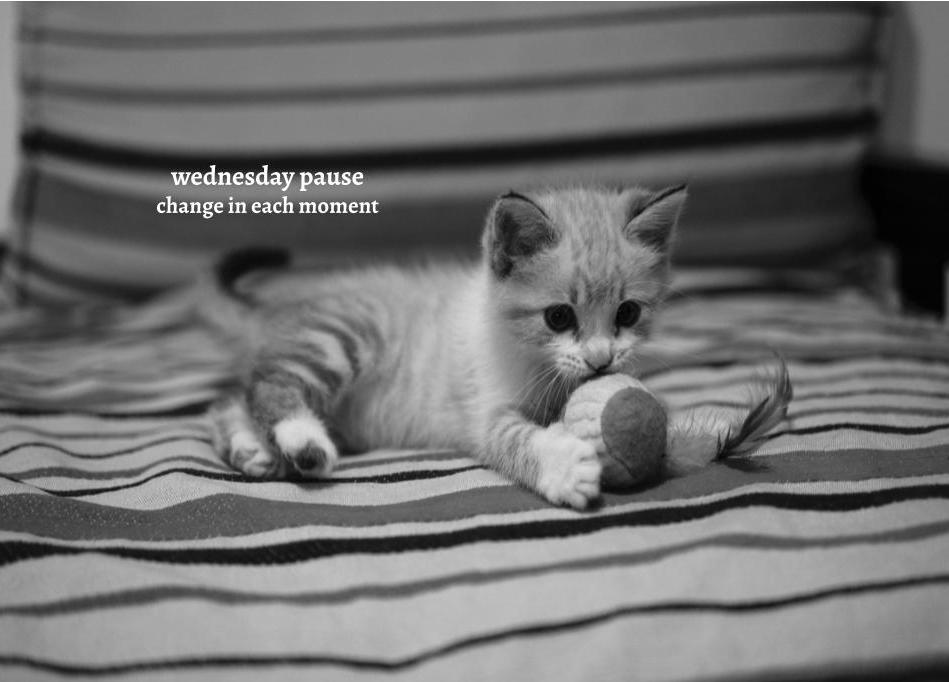
Noticing each moment as thoughts and feelings change, noticing how transient our experiences are. One moment we’re upset, shortly after that we’re fine, and the cycle continues. As we learn to embrace change moment-by-moment, it helps us embrace changes and new chapters in our lives that take us out of our comfort zone. Inspired by New Chapter, a poetry written by Denis Martindale (extract).
Attention and compassion are twins that keep us in the present moment instead of living in the past and future which is exhausting and distressing. To cultivate compassion, wishing well is the mantra of our Wednesday Pause meditation for #WorldMentalHealthDay.
Wishing well a person whom you have an easy relationship with, someone who is experiencing difficulty, yourself in the midst of a difficult time, and those around you.
It’s possible that wishing yourself well might be the most awkward, even seemingly un-deserving. It could also be triggering, leading to more judgments, what is called a backdraft.
The purpose is to bring to bear an intention rather than to create any special feelings. And so the invitation is to keep wishing yourself well, bit by bit like dipping your toes in a cold pond.
This traditional Irish blessing comes to mind for you.
Often what makes it difficult to accept change is the experiences that are triggered such as anxiety, sadness, fear of the unknown. Ruminating on it only compounds the suffering. This practice is about cultivating the capacity to welcome change, even those we don’t like, in order to ease into stepping out of our comfort zone and taking risks. Poetry for today is Change by Kathleen Raine.







 Kindermind Center